
Aitkin County Release Date Types
Minnesota Department of Corrections uses the exact field name “Anticipated Release Date.” It estimates prison exit under the current sentence calculation. “Expiration Date” marks the end of the sentence or MNDOC jurisdiction. An “Under Supervision as of” date records a prison-to-community supervision transition. These labels answer different questions. None should be relabeled as an actual Aitkin County Jail release time.
A pretrial person has not yet received a final custodial sentence. Bond, a release order, dismissal, plea, sentencing, a detainer, or transfer can change the next custody step. A sentenced county-jail person may have a court-ordered term and jail credit, yet Aitkin's official current roster displays only a booked date, agency, charges, and current custody. It contains no scheduled or actual release field. For an executed state-prison term, MNDOC calculates and publishes the state field while the person remains under its jurisdiction.
| Date or status | Meaning | Best source |
|---|---|---|
| Anticipated Release Date | Current estimate of state prison exit | MNDOC Public Viewer |
| Under Supervision as of | State prison portion ended and community supervision began | MNDOC Public Viewer |
| Expiration Date | End of sentence or MNDOC jurisdiction | MNDOC record |
| Court-ordered release | Legal authority for a custody change | Aitkin court file |
| Actual release date and time | Physical endpoint of jail custody | Aitkin Sheriff release record |
Find Aitkin County Release Dates
Start with custody type. The MNDOC locator covers adults committed to the Commissioner who remain under state corrections jurisdiction, whether incarcerated or under community supervision. It does not calculate Aitkin County Jail stays. The county roster is current-only. Court Administration can supply the sentencing order, while Jail or Sheriff Records can confirm the physical release or transfer event.
- Determine whether the person is in Aitkin County Jail, an MNDOC institution, or another agency's custody. Do not infer the custodian from the county of conviction.
- For state prison, search the MNDOC Public Viewer by offender ID when possible. Otherwise use first and last name.
- Match birth date, aliases, offense, and Aitkin court file. Then read Current Status, Sentence Date, Anticipated Release Date, and Expiration Date.
- For an Aitkin jail sentence, obtain the sentencing order and stated jail credit from the court. Ask Jail or Records for current calculation and actual release data.
- After the event, look for “Under Supervision as of” in a state record or request the Sheriff's release date, time, and legal basis for a jail event.
The official example record demonstrates the exact state labels. Open the MNDOC Anticipated Release Date example before comparing the captured field layout.
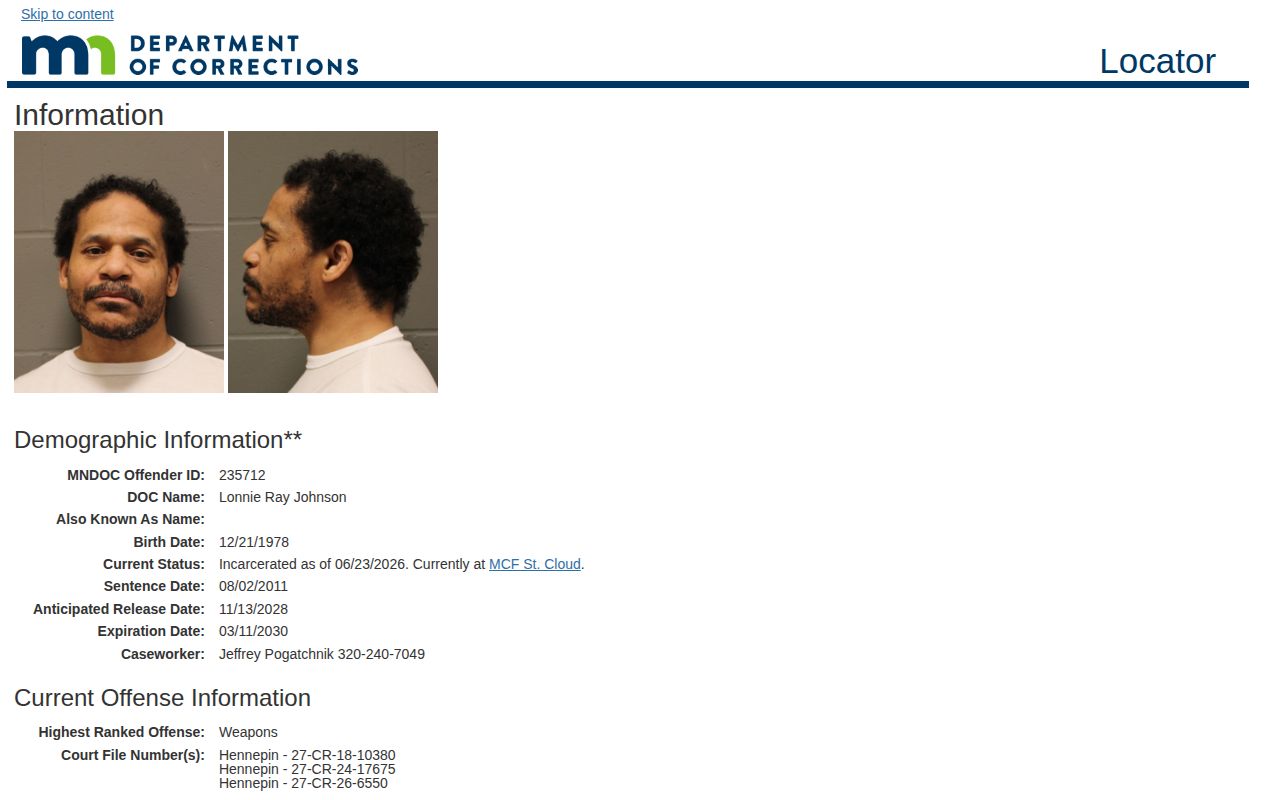
The sample shows how MNDOC separates Anticipated Release Date from Expiration Date. The dates belong to that example record, not to another Aitkin County case.
If a state record no longer appears after full discharge, contact MNDOC Central Records at co-records.doc@state.mn.us. For a county-jail event, Sheriff Records can be reached at 218-927-7433 or 218-927-7434. A broader Aitkin County release lookup can establish the custody path before any date is interpreted.
Note: Newly sentenced people may take several business days to appear in the MNDOC public search, so confirm recent commitments directly.
Aitkin State Release Calculation
Minnesota does not use a generic rule that each person serves eighty-five percent. For qualifying crimes committed on or after August 1, 1993, Minn. Stat. §244.01 defines the term of imprisonment as two-thirds of the executed sentence. The executed sentence is the total commitment. Minn. Stat. §244.05 assigns the remaining one-third to supervised release, subject to discipline and other statutory terms.
This baseline explains the structure but does not calculate a named person's date. Jail credit, concurrent or consecutive terms, disciplinary confinement, conditional-release provisions, amended court documents, and earned incentive credit can affect the result. Some cases also fall under older or special rules. Multiplying the sentence by one fraction can therefore produce a false date.
- Executed sentence
- The full court-imposed commitment used in the state sentence structure.
- Term of imprisonment
- The statutory prison portion, adjusted under applicable sentence rules.
- Supervised release
- The community portion of the state sentence after prison exit.
- Jail credit
- Custody time credited by the court toward the sentence calculation.
- Detainer
- A hold or request from another authority that can affect the next custody destination.
Supervised release is not final discharge. A person may leave prison and still be under MNDOC jurisdiction. The public viewer can state “Under Supervision” and identify an agent or district. Expiration Date remains the better label for the expected jurisdiction endpoint.
Aitkin Earned Release Credit
The Minnesota Rehabilitation and Reinvestment Act created individualized earned incentive release credit. Section 244.41 defines the credit in relation to objectives in an individualized rehabilitation plan. Section 244.43 requires MNDOC policy for awards and programming. Section 244.44 controls the calculation and limits.
Credit is included when the imprisonment term is calculated. It is not added to the supervised-release term, whose total length remains unchanged. The most that can be subtracted is seventeen percent of the total executed sentence, and the credit cannot reduce imprisonment below one-half of the executed sentence. The award is individual, not automatic. It depends on eligibility, plan objectives, actual awards, and the governing record.
Credit can be revoked for facility-rule violations or criminal acts. No one should turn the maximum into a promise that every eligible person earns it, serves one-half, or follows a universal eighty-three-percent rule. The published Anticipated Release Date is the practical public field because MNDOC applies the case data and current credit record.
Aitkin Release Dates Can Change
“Anticipated” signals that the calculation can move. Discipline or refusal of required rehabilitative programming may delay supervised-release placement. Earned incentive credit can be revoked. Courts can correct jail credit, resentence, or amend a warrant of commitment. A new sentence or a change in concurrent and consecutive terms can also alter the calculation.
| Factor | Possible effect | Where to confirm |
|---|---|---|
| Discipline | Additional confinement or delayed supervised release | MNDOC status and sentence record |
| Earned credit award or revocation | Changes the current imprisonment calculation | MNDOC record under statutory policy |
| Corrected jail credit | Changes time credited toward the sentence | Court order and MNDOC calculation |
| Amended sentence | Changes the executed term or sentence structure | Aitkin court file |
| Concurrent or consecutive terms | Changes how multiple sentences combine | Court and MNDOC records |
| Detainer or other hold | May change destination or prevent community release | Holding and receiving agencies |
| Release-plan requirement | May delay physical release in an applicable case | MNDOC or Board record |
A Supervised Release Board decision applies only to its narrow caseload. A grant can still be subject to an approved release plan, another sentence, or a future date. For routine determinate cases, the statute and MNDOC calculation generally control instead of a parole hearing. A Board eligibility date must never be presented as an automatic release date.
Aitkin Weekend Release Rules
Minnesota has a state-prison calendar adjustment in §244.05, subdivision 1a. For crimes committed before August 1, 1992, supervised release scheduled on Friday, Saturday, Sunday, or a legal holiday begins on the last prior day that is not one of those days. For crimes committed on or after that date, it begins on the first following day that is not Friday, Saturday, Sunday, or a legal holiday.
This provision belongs to state supervised release. It is not evidence of an Aitkin County Jail policy for bond, time served, property return, or ordinary release processing. No official local good-time or release-day computation policy was found in the reviewed Aitkin sources. For a county sentence, use the court's sentencing order, stated jail credit, and direct Jail or Records confirmation.
The date-of-offense distinction also shows why a broad weekend rule is unsafe. Two Minnesota cases can use opposite calendar directions under the same subdivision because they fall on different sides of the statutory date. The official statute and individual sentence record should settle the issue.
Note: Minnesota's weekend provision concerns state supervised release and must not be imported into an ordinary Aitkin jail calculation.
Aitkin Jail Release Dates
The MNDOC Anticipated Release Date does not calculate a normal Aitkin County Jail stay. The county's PDF lists current inmates and a booked date, but no scheduled release, release reason, bond amount, destination, or actual release time. A person absent from that PDF may have been released, transferred to another county, delivered to MNDOC, or removed after another court-directed custody change.
For a sentenced jail stay, read the Aitkin sentencing order and any stated custody credit through the county Court Administration route. Then ask Jail or Sheriff Records whether a maintained calculation or release event is available. The official Aitkin County Jail page supplies current contact information. The public release record should identify date, time, and legal basis. If custody transferred, the public data should identify transfer date, time, legal basis, and receiving agency. Those fields distinguish community release from continued confinement.
A pretrial detainee has no sentence-based release date to calculate. Bail conditions, a later order, dismissal, plea, sentencing, warrants, and other holds may control. MCRO can show court action, but the Sheriff's timestamp remains the stronger source for the physical jail exit. The court order and jail record answer related but distinct questions.
Confirm Aitkin County Release
After a future date passes, do not assume the planned event occurred as first calculated. For state prison, reopen the MNDOC record and look for a current status such as “Under Supervision as of,” along with the listed agent or district. For a formal historic record, contact MNDOC Central Records. For county jail, request the Sheriff's actual release or transfer fields.
Minnesota VINE can send an Aitkin County Jail custody event, but it does not cover MNDOC prisons. A person moving into state prison requires Minnesota Haven for prison notices. The resolved VINE Inmate Check explains the county-jail registration and the notification boundary. An alert prompts verification. It does not replace the agency's maintained record.
Use exact terms in any request. Ask whether the date was anticipated, court ordered, alerted, physically recorded, or the final expiration of jurisdiction. That small distinction prevents a future estimate from being repeated as an actual release and prevents a transfer from being mistaken for freedom from custody. It also makes clear whether the next check belongs with the court, the jail, MNDOC, or another receiving agency.